

A wireless tire pressure monitoring system helps drivers monitor tire pressure and temperature without running wires from every tire position to the display monitor. Instead, TPMS sensors send tire data wirelessly to a monitor inside the vehicle, tow vehicle, RV, truck, or cab.
Wireless TPMS is especially useful for RVs, travel trailers, fifth wheels, semi trucks, buses, fleets, motorcycles, and heavy-duty vehicles where some tires are difficult to inspect while driving or towing.
This guide explains how a wireless TPMS system works, what problems it can help detect, why sensor signal matters, and when a Hard-Wired TPMS Signal Booster for Talon Systems may help improve communication on long vehicles, trailers, and heavy-duty setups.
What Is a Wireless Tire Pressure Monitoring System?
A wireless tire pressure monitoring system is a TPMS that uses sensors to monitor tire pressure and temperature, then sends that information wirelessly to a display monitor.
Instead of checking every tire manually during a trip, the driver can see tire pressure and temperature readings from the monitor. This helps provide better visibility before a small tire issue becomes a road problem.
Most wireless TPMS setups include:
- TPMS sensors installed on tire valve stems or inside the tire assembly.
- A monitor that displays tire pressure and temperature readings.
- Warning alerts for abnormal tire pressure or temperature.
- Optional signal support for longer vehicles, trailers, or rear tire positions.
How Does a Wireless TPMS System Work?
A wireless TPMS system works by placing a sensor at each tire position you want to monitor. Each sensor reads tire pressure and temperature, then sends that data to the monitor.
The monitor displays the tire readings so the driver can check the condition of each monitored tire while driving or towing. If pressure drops, temperature rises, or the system detects an abnormal condition, the monitor can alert the driver.
Wireless tire pressure monitoring is useful because tire problems often start before the driver can see or feel them. This is especially true for trailer tires, rear tire positions, dual axles, and long vehicles.
Is TPMS Wireless?
Many aftermarket TPMS systems are wireless, but not every TPMS works the same way. Some factory systems are integrated into the vehicle, while aftermarket wireless systems often use external sensors and a dedicated monitor.
For RVs, trailers, semi trucks, buses, motorcycles, and fleet applications, wireless TPMS is practical because it can monitor tire positions that may not be covered by the factory vehicle system.
Are TPMS Sensors Wireless?
Many TPMS sensors are wireless because they transmit tire pressure and temperature data to a monitor or receiver. In aftermarket wireless TPMS systems, external sensors are commonly used because they are easier to install, access, service, and replace.
Wireless sensors are especially useful for vehicles with multiple tire positions, including RVs, travel trailers, fifth wheels, semi trucks, buses, and fleet vehicles.
Why Wireless TPMS Is Useful for RVs, Trailers and Trucks
A wireless TPMS is useful when the driver needs tire visibility beyond what can be checked from the driver’s seat. Trailer tires, rear tires, dual tires, and multi-axle setups can be difficult to inspect while driving.
A wireless tire pressure monitoring system can help detect:
- Low tire pressure.
- High tire pressure.
- Rising tire temperature.
- Slow leaks.
- Rapid pressure loss.
- Missing tire readings.
- Rear tire or trailer sensor signal loss.
For towing and heavy-duty applications, this visibility matters because tire issues can happen behind the driver, where they may not be noticed immediately.
Wireless Tire Pressure Monitoring for Trailers
A wireless trailer tire pressure monitoring system helps monitor trailer tires from the tow vehicle. This is useful for travel trailers, fifth wheels, camper trailers, utility trailers, and multi-axle towing setups.
Trailer tires are behind the tow vehicle, so the driver may not notice a slow leak, rising temperature, or pressure loss until damage has already started. A wireless TPMS gives the driver tire data while towing.
When choosing a wireless TPMS for trailers, consider:
- The number of trailer tires.
- The trailer length.
- The tire pressure range.
- The sensor type.
- The monitor location.
- Whether a signal booster is needed.
Wireless TPMS for Semi Trucks and Commercial Vehicles
Wireless TPMS is also useful for semi trucks, commercial trucks, buses, and fleet vehicles. These applications often involve more tire positions, longer routes, higher pressure requirements, and heavier operating conditions.
For commercial or heavy-duty use, the system should support the correct wheel count, pressure range, sensor type, and signal distance. A basic passenger-vehicle TPMS is not the same as a heavy-duty wireless tire pressure monitoring setup.
What Features Should a Wireless TPMS System Have?
When comparing wireless tire pressure monitoring systems, focus on features that affect reliability and ease of use.
Pressure and Temperature Monitoring
The best wireless TPMS should monitor both tire pressure and tire temperature. Pressure readings help detect underinflation, overinflation, and leaks. Temperature readings can help identify abnormal heat conditions.
Correct Sensor Count
Choose a system that supports the number of tires you need to monitor. A motorcycle, travel trailer, RV, semi truck, and bus may all require different sensor counts.
Compatible Pressure Range
Make sure the system supports the tire pressure range required by your vehicle. Heavy-duty vehicles, trailers, and commercial applications may require higher pressure support than passenger vehicles.
External Sensors with Serviceable Parts
External TPMS sensors are practical for many aftermarket setups because they are easier to install, access, service, and replace. Replaceable batteries and service parts can also make long-term maintenance easier.
Clear Monitor and Alerts
The monitor should make it easy to see tire pressure, temperature, warning alerts, and tire position data while driving.
Signal Booster Support
Long trailers, motorhomes, semi trucks, buses, and fleet vehicles may need a signal booster to improve communication between rear sensors and the monitor.
Why Signal Range Matters in Wireless TPMS
Wireless TPMS depends on communication between the tire sensors and the monitor. On shorter vehicles, the monitor may receive sensor data without extra support. On longer vehicles, trailers, fifth wheels, and heavy-duty setups, distance and vehicle structure can make communication more difficult.
Signal issues may appear as:
- Rear tire readings dropping out.
- Trailer tire readings disappearing from the monitor.
- Slow or inconsistent sensor updates.
- One or more distant sensors not reading while closer sensors work normally.
- Signal loss on long trailers, RVs, buses, or fleet vehicles.
When this happens, the problem may not be the sensor itself. It may be signal distance between the sensor and the monitor.
When Does a Wireless TPMS Need a Signal Booster?
A wireless TPMS may need a signal booster when the distance between the tire sensors and the monitor is too long for consistent communication.
A booster may help if:
- You tow a long travel trailer.
- You drive a fifth wheel or large RV.
- Your rear tire sensors drop out.
- Your trailer sensors read inconsistently.
- Your semi truck, bus, or fleet vehicle has distant tire positions.
- Closer sensors work but rear sensors lose signal.
If one sensor fails even when close to the monitor, check the battery, pairing, valve stem, and sensor condition first. If distant sensors are the ones dropping out, signal distance may be the issue.
Recommended Product: Hard-Wired TPMS Signal Booster for Talon Systems
The Hard-Wired TPMS Signal Booster for Talon Systems is designed to improve communication between compatible HawksHead TALON sensors and the monitor when distance or vehicle length creates signal problems.
This product is especially useful for long trailers, travel trailers, fifth wheels, RVs, semi trucks, buses, fleets, towable setups, and applications where rear tire sensors may be far from the display monitor.
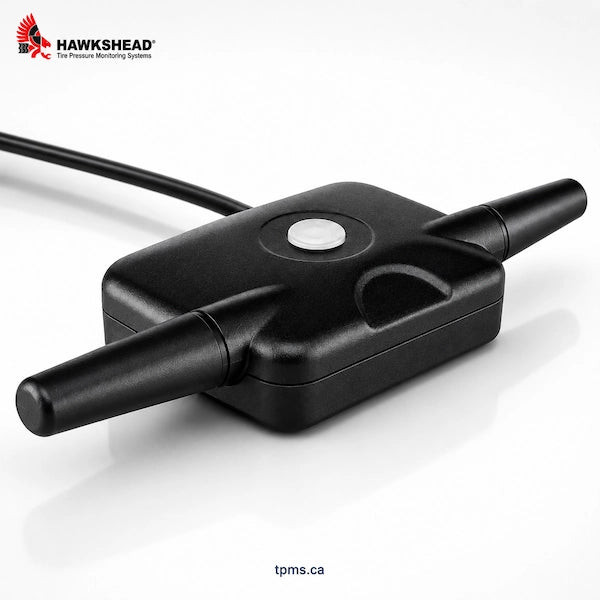
RECOMMENDED SIGNAL SUPPORT
Hard-Wired TPMS Signal Booster for Talon Systems
Improve rear sensor communication on long trailers, RVs, semi trucks, buses, fleets, and compatible HawksHead TALON setups where wireless signal distance can become a limitation.
- Helps reduce rear sensor signal dropouts
- Useful for long trailers and towable setups
- Designed for compatible TALON systems
- Supports more reliable wireless TPMS communication
Signal Booster vs Sensor Replacement
A signal booster and a replacement sensor solve different problems.
A signal booster helps when the sensor works but the monitor has trouble receiving its signal because of distance, vehicle length, or obstruction.
A replacement sensor may be needed if:
- The sensor does not transmit even when close to the monitor.
- The sensor battery is dead.
- The sensor body is damaged.
- The sensor will not pair with the monitor.
- The seal, O-ring, or valve connection is damaged.
Use this simple rule: if nearby sensors work and far sensors drop out, consider a signal booster. If one sensor fails everywhere, check the sensor, battery, pairing, and valve connection first.
How Many Wireless TPMS Sensors Do You Need?
The number of sensors depends on how many tire positions you want to monitor.
- Single-axle trailer: usually 2 sensors.
- Dual-axle trailer: usually 4 sensors.
- Triple-axle trailer: usually 6 sensors.
- RV or motorhome: based on total wheel positions.
- Semi truck or bus: based on total monitored tire positions.
- Spare tire monitoring: add one sensor per spare tire.
Before choosing a system or accessories, count the tires you want to monitor and confirm that your wireless TPMS supports that wheel count.
Common Wireless TPMS Problems
Most wireless TPMS problems come from battery condition, pairing, sensor placement, signal distance, valve connection, or compatibility.
Common issues include:
- The monitor is not reading one sensor.
- The monitor is not reading trailer sensors.
- The sensor battery is weak.
- The sensor is not paired correctly.
- The sensor is assigned to the wrong tire position.
- The signal is weak on a long vehicle or trailer.
- The valve stem or sensor seal is damaged.
Wireless TPMS Buying Checklist
Before choosing or upgrading a wireless tire pressure monitoring system, answer these questions:
- What vehicle or trailer do you need to monitor?
- How many tires need sensors?
- What tire pressure range do you need?
- Do you need pressure and temperature monitoring?
- Is the vehicle or trailer long enough to need a booster?
- Do you prefer external sensors with replaceable batteries?
- Will T-Valve adapters make pressure checks easier?
- Do you need support manuals or setup videos?
Final Recommendation
A wireless tire pressure monitoring system is useful because it gives drivers real-time tire pressure and temperature visibility without wiring every tire position to the monitor.
For RVs, trailers, semi trucks, buses, fleets, motorcycles, and heavy-duty vehicles, wireless TPMS reliability depends on the correct sensors, wheel count, pressure range, valve setup, and signal strength.
If your monitor is not reading rear sensors, if trailer tire readings drop out, or if distant tire positions update inconsistently, the issue may be signal distance. For compatible HawksHead TALON systems, the Hard-Wired TPMS Signal Booster for Talon Systems can help improve wireless communication and support more reliable tire monitoring.
Explore the HawksHead Hard-Wired TPMS Signal Booster to improve sensor communication on long trailers, towable setups, RVs, semi trucks, buses, and other compatible TALON applications.
Frequently Asked Questions About Wireless Tire Pressure Monitoring Systems
What is a wireless tire pressure monitoring system?
A wireless tire pressure monitoring system is a TPMS that uses sensors to send tire pressure and temperature data to a monitor without running wires from each tire position.
How does a wireless TPMS system work?
A wireless TPMS system uses sensors installed on tire positions to measure pressure and temperature. The sensors transmit that data wirelessly to a monitor so the driver can see tire conditions while driving.
Is TPMS wireless?
Many aftermarket TPMS systems are wireless, especially systems for RVs, trailers, trucks, motorcycles, and fleets. Some factory systems are integrated differently depending on the vehicle.
Are TPMS sensors wireless?
Many TPMS sensors are wireless because they transmit tire data to a monitor or receiver. In aftermarket systems, external sensors commonly send pressure and temperature readings wirelessly to the display.
Can wireless TPMS monitor tire temperature?
Yes. Compatible wireless TPMS systems can monitor both tire pressure and tire temperature when used with the correct sensors and monitor.
Do wireless TPMS systems need a signal booster?
Some wireless TPMS systems need a signal booster when the vehicle, trailer, or towing setup is long enough to make communication between rear sensors and the monitor less reliable.
When should I use a TPMS signal booster?
Use a TPMS signal booster when rear tire sensors, trailer sensors, or distant tire positions drop out while closer sensors continue reading normally.
Can a signal booster fix a dead TPMS sensor?
No. A signal booster helps with communication distance. If the sensor battery is dead, the sensor is damaged, or the sensor is not paired, those issues must be fixed first.
Is wireless TPMS good for trailers?
Yes. Wireless TPMS is useful for trailers because trailer tires are behind the tow vehicle and harder to inspect while driving. A trailer TPMS helps monitor pressure and temperature while towing.
What is the best wireless TPMS accessory for long trailers?
For compatible HawksHead TALON systems, the Hard-Wired TPMS Signal Booster is a practical accessory when long trailers, fifth wheels, or towable setups need stronger rear sensor communication.

