

Choosing the best TPMS for a travel trailer starts with the trailer itself: tire count, operating pressure, valve configuration, towing distance, and the number of tire positions you want to monitor. A properly selected tire pressure monitoring system should give you real-time pressure and temperature visibility from the tow vehicle without making routine tire checks or inflation unnecessarily difficult.
Before buying a system, compare sensor capacity, pressure range, valve access, and the distance between the trailer tires and the monitor. If you already know your tire configuration and are ready to compare complete systems, browse our Trailer Tire Pressure Monitoring Systems.
What Should a Travel Trailer TPMS Monitor?
A travel trailer TPMS should provide real-time pressure and temperature information for each monitored trailer tire while you are towing.
Because trailer tires are positioned behind the tow vehicle, pressure loss or rising temperature can be difficult to detect from the driver's seat. A TPMS gives you continuous visibility into those tire positions and can alert you when readings move outside the limits configured in the system.
The monitor should also identify the affected tire position so you can determine which tire requires attention.
TPMS does not replace regular tire maintenance. Cold-pressure checks, valve inspections, tread inspections, and routine tire service should still be part of your pre-trip process.
How to Choose the Best TPMS for a Travel Trailer
The best TPMS for a travel trailer is not simply the system with the most sensors. It should match your actual tire configuration, operating pressure, valve setup, and towing distance.
1. Count Every Trailer Tire
Start by counting every tire position you want to monitor.
A single-axle travel trailer commonly has two tire positions, while a tandem-axle trailer commonly has four. Triple-axle and other multi-axle trailers require additional sensors.
If you also want to monitor a spare tire, include it when calculating the total sensor capacity required.
Choose a TPMS monitor that supports your complete configuration and leaves enough capacity if you expect to add more monitored tire positions later.
2. Check the Tire Pressure Range
Confirm the recommended cold inflation pressure for your trailer tires before selecting a TPMS.
The sensors and monitor must support the operating pressure range required by your tires. Do not assume that every TPMS sensor is suitable for every trailer tire.
Pressure capability should be confirmed before ordering the system.
3. Choose the Right Sensor Configuration
External TPMS sensors are commonly used for aftermarket travel trailer monitoring because they can be installed on compatible valve stems without removing the tire from the wheel.
They are also easier to access when a sensor needs to be serviced, removed, or replaced.
Internal sensors are installed inside the wheel and normally require tire service for installation or replacement.
The right option depends on your preferred installation method, valve configuration, maintenance requirements, and compatibility with the TPMS monitor.
4. Consider Valve Access
A TPMS sensor should not make routine tire inflation unnecessarily difficult.
Before choosing a sensor configuration, check how easily you can reach each valve stem and whether you must remove the sensor every time tire pressure needs to be adjusted.
For compatible external sensor installations, a T-Valve can provide a separate inflation point while allowing the TPMS sensor to remain installed.
This can be especially useful when valve access is limited or when tire pressure needs to be checked frequently.
5. Check Sensor-to-Monitor Distance
The distance between the trailer tires and the TPMS monitor matters.
Long travel trailers, fifth wheels, and multi-axle towing configurations can place the rear tire sensors much farther from the monitor inside the tow vehicle.
If the distance becomes too great or vehicle structure interferes with communication, rear sensor readings may become inconsistent.
Consider signal range when choosing the system, especially if you have a long trailer or frequently experience communication loss from the rear tire positions.
6. Leave Room for Additional Sensors
Your towing configuration may change over time.
You may later decide to monitor:
- A spare trailer tire.
- Additional trailer tire positions.
- A different trailer configuration.
- Other compatible tire positions supported by the monitor.
Choosing a TPMS with available sensor capacity gives you more flexibility.
Always confirm the maximum number of sensors supported by the specific monitor before expanding the system.
How Many TPMS Sensors Does a Travel Trailer Need?
You generally need one compatible TPMS sensor for each trailer tire position you want to monitor.
| Travel Trailer Setup | Common Tire Count | Typical Sensor Requirement |
|---|---|---|
| Single axle | 2 tires | 2 sensors |
| Tandem axle | 4 tires | 4 sensors |
| Triple axle | 6 tires | 6 sensors |
| Monitored spare tire | 1 additional tire | Add 1 sensor |
These examples are only a starting point. Always count the actual tire positions on your trailer before selecting a system.
If you need a more detailed explanation, read our guide on How Many TPMS Sensors an RV or Trailer Needs.
External vs. Internal TPMS Sensors for Travel Trailers
External and internal TPMS sensors perform the same basic job: transmitting tire information to the monitoring system. The main difference is where the sensor is installed and how it is serviced.
External TPMS Sensors
External sensors attach to compatible tire valve stems.
They are commonly selected for aftermarket trailer installations because they can usually be installed without dismounting the tire.
External sensors can also be easier to remove, replace, or service.
For more information, read our guide to External TPMS Sensors for RVs and Trailers.
Internal TPMS Sensors
Internal sensors are installed inside the wheel.
Because tire removal is normally required for installation and replacement, they are generally more involved to service.
Neither configuration is automatically the best option for every trailer. Valve compatibility, installation preference, maintenance access, and monitor compatibility should determine which sensor type is appropriate for your setup.
Does a Travel Trailer TPMS Need a Signal Booster?
Not every travel trailer requires a TPMS signal booster.
Additional signal support becomes more relevant when the distance between the trailer sensors and monitor increases or when the vehicle structure interferes with wireless communication.
Consider signal range if:
- Rear trailer sensors repeatedly lose communication.
- Some tire positions display normally while others disappear.
- The trailer creates a long sensor-to-monitor distance.
- Readings from the farthest sensors become intermittent while towing.
- Communication problems should be diagnosed before replacing sensors.
If distance appears to be the cause, review our TPMS Signal Booster Guide to understand when additional signal support may help.
Travel Trailer TPMS Checklist Before Buying
Before choosing a travel trailer TPMS, confirm the following:
- Total number of trailer tires you want to monitor.
- Whether you also want to monitor the spare tire.
- Recommended tire pressure for the trailer tires.
- TPMS sensor pressure range.
- Maximum sensor capacity of the monitor.
- Sensor compatibility with your valve stems.
- Valve accessibility for routine inflation.
- Distance between the trailer tires and monitor.
- Whether additional signal support may be required.
- Availability of compatible replacement sensors.
- Availability of compatible valves and service components.
Once these points are clear, you can compare systems based on your actual trailer configuration instead of choosing only by price or the number of sensors included in the box.
Travel Trailer TPMS for Fifth Wheels
Fifth wheels should be evaluated using the same basic criteria as other travel trailers, but their length and tire configuration can make monitoring distance especially important.
Start by counting every tire position on the fifth wheel and confirming the required pressure range.
Then consider the distance between the rear sensors and the monitor in the tow vehicle.
Multi-axle fifth wheels may require more sensor positions than smaller travel trailers, so monitor capacity should be confirmed before purchasing the system.
If rear sensors have difficulty communicating with the monitor, signal range should also be evaluated.
Why Tire Temperature Matters on a Travel Trailer
Tire pressure is not the only measurement worth monitoring while towing.
Changes in tire temperature can provide additional information about what is happening at an individual tire position.
An unusual temperature increase may indicate that a tire or wheel position needs attention.
A TPMS that provides both pressure and temperature information gives the driver more visibility than relying only on periodic pressure checks at stops.
Temperature readings should be treated as another monitoring signal rather than a substitute for tire inspection and maintenance.
Where to Shop for a Travel Trailer TPMS
Once you know your tire count, pressure range, sensor configuration, valve requirements, and monitoring distance, the next step is comparing complete systems.
HawksHead Trailer Tire Pressure Monitoring Systems are available for travel trailers, fifth wheels, and other towable configurations with different sensor capacities and monitoring requirements.
Shop Trailer Tire Pressure Monitoring Systems →
Travel Trailer TPMS FAQs
What should I look for in a travel trailer TPMS?
Look for a system that supports your total tire count, required pressure range, sensor configuration, valve setup, and sensor-to-monitor distance. The monitor should also have enough capacity for any additional tire positions you may want to monitor later.
How many TPMS sensors do I need for a travel trailer?
You generally need one compatible sensor for every trailer tire position you want to monitor. A tandem-axle travel trailer with four tires will typically require four sensors. Add another sensor if you also want to monitor a compatible spare tire position.
Should a travel trailer TPMS monitor temperature?
Pressure and temperature monitoring provide additional visibility into trailer tire conditions while towing. Compatible HawksHead TPMS sensors transmit both tire pressure and temperature information to the monitor.
Do I need a TPMS signal booster for a travel trailer?
Not necessarily. A signal booster becomes more relevant when trailer length, sensor distance, or vehicle structure affects communication between the rear sensors and monitor. If readings remain reliable without additional signal support, a booster may not be necessary.
Are external TPMS sensors good for travel trailers?
External TPMS sensors are a practical aftermarket option for many travel trailers because they can be installed on compatible valve stems without removing the tire. Confirm valve compatibility, pressure range, and monitor compatibility before choosing them.
Can I add more TPMS sensors later?
Compatible TPMS systems can support additional sensors up to the maximum capacity of the monitor. Check the specific monitor capacity before purchasing additional sensors.
Does TPMS replace manual tire pressure checks?
No. TPMS provides real-time monitoring while traveling, but regular cold-pressure checks, valve inspections, tread inspections, and other tire maintenance should still be performed.
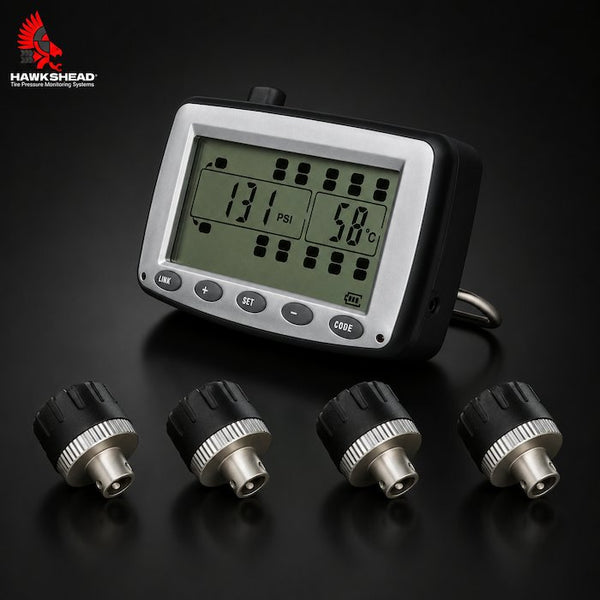
RECOMMENDED TRAILER TPMS
Talon 22 TPMS System with 4 Aluminum Cap Sensors
A practical HawksHead TPMS setup for many travel trailers, fifth wheels, camper trailers, and multi-axle towing applications. Monitor tire pressure and temperature from the tow vehicle while you drive.
- Monitors pressure and temperature across trailer tire positions
- Includes 4 external aluminum cap sensors
- Supports multi-wheel monitoring up to 22 wheels
- Useful for travel trailers, fifth wheels, and towing setups

